
Level 1 Society
Welcome to the Level 1 Society Guidebook, a platform dedicated to an optimistic vision of the future inspired by the groundbreaking ideas of Gene Roddenberry in 1964. This guidebook explores a future where humanity not only ventures into outer space but also successfully addresses and overcomes many social and political challenges. Roddenberry’s foresight presents a beacon of hope and possibility, portraying a world where space exploration goes hand-in-hand with societal and political triumphs.
More than just science fiction, this vision continues to inspire and provoke thought, offering a hopeful narrative that encourages us to strive for a better, more inclusive future. Join us as we delve into the possibilities of what humanity can achieve when we work together towards a common goal.
$9.99 for a limited time only
*By purchasing you agree to the Terms & Conditions





The Gen1 Enterprise will have three primary engines. These engines will be mounted on the aft ends of the three cylindrical-like hulls. As shown above, the main engine hull will contain the main engine and the two aux engine hulls will contain the two aux engines.
These three engines will all be ion propulsion type engines, sometimes also known as ion thrusters. The thrust created by an ion propulsion engine is very small compared to conventional chemical rockets, but these engines have a very high specific impulse, meaning they use propellant very efficiency. This high propellant efficiency is achieved by accelerating the propellant to very high speeds.
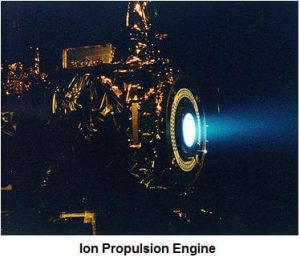
Image Credit – NASA
Ion propulsion engines typically are left running constantly while a craft is traveling to some destination in space. Thus the engines provide constant acceleration to the spacecraft. While this acceleration is very small compared to the acceleration imparted by a chemical rocket, over time a small, constant acceleration can propel the spacecraft to very high speeds. It’s a case of the tortoise vs. the hare when it comes to comparing ion propulsion engines to chemical rocket engines. With ion propulsion engines that run continually it’s possible to reach far off places in a reasonably short amount of time.
As a goal, the Gen1 Enterprise will use .0001g constant acceleration when traveling outside of earth’s orbit. Since the Enterprise is built entirely in space, and never needs to be able to launch itself from earth into orbit, there is no need for the primary engines to ever use high thrust.
Ion propulsion engines are electrically powered and are thus classified as electric propulsion engines. As derived here, the main engine uses 1.5GWe of electrical power and each aux engine will use .5GWe of electrical power. This electrical power is supplied by a nuclear power system on board the Gen1 Enterprise.
An example of an ion propulsion engine which has had considerable research is the VASIMR engine which is the brainchild of Costa Rican scientist and former astronaut Franklin Chang Diaz. He is CEO of the Astra Rocket Company that is developing variations of the VASIMR. The Astra Rocket Company has a concept for a 200MWe VASIMR. This is near the range of what is needed for one of the .5GWe Aux Engines of the Gen1 Enterprise. (.5GWe = 500MWe.)
Here is a list of advantages for using ion propulsion engines in the Gen1 Enterprise over chemical rocket engines:
- High specific impulse allows much less propellant to be carried onboard the ship, thus lowering its overall wet mass.
- Safer than chemical rockets since there are no ignited materials in the engines.
- The propellant gas used in the ion propulsion engines will be non-flammable and thus safer when stored in tanks and routed through pipes to the engines.
- Very long engine life. Ideal for the Enterprise whose engines must last for decades.
- Lends itself to being powered by a nuclear reactor that is used to generate electricity. Nuclear reactors have a very long life as a power source, which is a great fit for the Enterprise.
- A low .0001g constant acceleration is so small that it does not interfere with the operation of the gravity wheel. The change in the gravity acting upon persons inside the wheel as the wheel spins is so slight that it will not be noticed.
Ship Specs
Engines
Power Systems
Shielding
Engines
Ship Development Philosophy

About the author.

Dr. Myers brings 24 years of diverse field experience, having contributed significantly to multiple domains. Notably, from 2000 to 2016, Dr. Myers was an integral part of a think tank group led by a retired US Marshal, collaborating closely with esteemed professionals such as US Navy Capstone John Shelbourne in high-end Research & Development and retired NASA Yellow Team scientist Bob Berman. During this time, Dr. Myers gained profound insights into nanotechnology and various cutting-edge technologies.
Dr. Myers’ expertise extends beyond technology, encompassing cross-correlating scientific consulting, manufacturing, business plan operations, patents, and understanding global societies. Academically, Dr. Myers holds dual bachelor’s degrees in Game Design and Global Business Management, a Master’s in Business, and a PhD in Organizational Leadership.
With a rich background in consulting across various fields, Dr. Myers has successfully helped businesses grow, some of which were sold or transitioned into retirement. Constantly evolving, Dr. Myers now shares a unique perspective on how the world can progress towards a “Star Trek” society, where the majority of our economic problems are solved, fostering a future of innovation and collaboration.
Dr. Myers

Books Coming Soon~

Dr Myers Auto Biography

Battle Tech Knights
Salesforce Application Development Leadership

Upcoming book!
Part 2 Level 1 Society A Energy & Financial Blueprint To A Global Society Of Evolution~

Discount on books.
Get updates, be part of a future community.