
Level 1 Society
Welcome to the Level 1 Society Guidebook, a platform dedicated to an optimistic vision of the future inspired by the groundbreaking ideas of Gene Roddenberry in 1964. This guidebook explores a future where humanity not only ventures into outer space but also successfully addresses and overcomes many social and political challenges. Roddenberry’s foresight presents a beacon of hope and possibility, portraying a world where space exploration goes hand-in-hand with societal and political triumphs.
More than just science fiction, this vision continues to inspire and provoke thought, offering a hopeful narrative that encourages us to strive for a better, more inclusive future. Join us as we delve into the possibilities of what humanity can achieve when we work together towards a common goal.
$9.99 for a limited time only
*By purchasing you agree to the Terms & Conditions




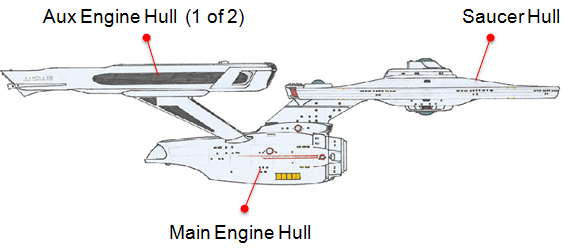
The Enterprise has four hulls: the saucer hull, the main engine hull, and the two aux engine hulls as shown above.
From the outside of the ship to any point on the interior of the ship at least three walls will be found for abiding by the design philosophy of triple redundancy for all key systems. The first wall, the outermost wall, creates the exterior surface of the ship. This is made of aluminum because aluminum is a proven material for handling the extreme temperature variations that the ship’s exterior surface must tolerate as the ship moves about in space.
The inner walls of the ship will be made of composite materials because they are lighter, stronger, and provide better shielding from radiation. These inner walls can also withstand the extreme temperature cycling that occurs in space, but perhaps not for years and years like aluminum can. But the composite walls can tolerate the temperature extremes for awhile as might be needed in case the aluminum exterior is ever damaged such as during a meteor strike or collision of some type. The inner walls then can take over the function of the outer aluminum wall until the aluminum can be repaired.
Except for the donut-shaped cavity in the saucer hull that houses the gravity wheel, the standard wall plan used in all four hulls is shown to the right.

The standard triple walls shown achieve 2.5 gram/cm2 of passive radiation shielding. The large 8 foot gap between the outermost wall and the middle wall is to provide a space for workers working on either of these walls. Also, this space allows for future upgrades to the hulls. Perhaps in the future active shielding equipment will be installed in the 8 foot space. Ideally, a future upgrade could provide an active shielding system to protect the whole ship from radiation in space.
For inside of the pods in the gravity wheel, more shielding is used since people will spend much more time in these pods than in the lesser shielded gravityless places in other parts of the ship. For these pods, four walls exist from the outside of the ship to the inside of a pod. The outer two walls are for the donut-shaped stationary cavity in the saucer hull that houses the floating gravity wheel, and the two other walls are for the pod in the rotating gravity wheel. These walls are collectively thicker than in other places of the ship to give more shielding but also to give them more mechanical strength to assure that the gravity wheel and the donut-shaped cavity are sturdy and will not come apart in the case of an emergency that somehow perturbs the normal operation of the gravity wheel. Shown below are the four walls. These walls collectively provide 6.25 gram/cm2 of shielding.

For estimates of the mass of the walls for all four hulls and all internal support structures (ribs, trusses, beams, lattice-work on walls, etc.), see this spreadsheet. The net mass of these combined structures is 60 million pounds as shown in the spreadsheet. This 60 million pound value is also used when rolling up the grand total mass of everything in the Enterprise (see table at the bottom of this page).
Ship Specs
Engines
Power Systems
Shielding
Engines
Ship Development Philosophy

About the author.

Dr. Myers brings 24 years of diverse field experience, having contributed significantly to multiple domains. Notably, from 2000 to 2016, Dr. Myers was an integral part of a think tank group led by a retired US Marshal, collaborating closely with esteemed professionals such as US Navy Capstone John Shelbourne in high-end Research & Development and retired NASA Yellow Team scientist Bob Berman. During this time, Dr. Myers gained profound insights into nanotechnology and various cutting-edge technologies.
Dr. Myers’ expertise extends beyond technology, encompassing cross-correlating scientific consulting, manufacturing, business plan operations, patents, and understanding global societies. Academically, Dr. Myers holds dual bachelor’s degrees in Game Design and Global Business Management, a Master’s in Business, and a PhD in Organizational Leadership.
With a rich background in consulting across various fields, Dr. Myers has successfully helped businesses grow, some of which were sold or transitioned into retirement. Constantly evolving, Dr. Myers now shares a unique perspective on how the world can progress towards a “Star Trek” society, where the majority of our economic problems are solved, fostering a future of innovation and collaboration.
Dr. Myers

Books Coming Soon~

Dr Myers Auto Biography
Battle Tech Knights
Salesforce Application Development Leadership

Upcoming book!
Part 2 Level 1 Society A Energy & Financial Blueprint To A Global Society Of Evolution~
Discount on books.
Get updates, be part of a future community.