
Level 1 Society
Welcome to the Level 1 Society Guidebook, a platform dedicated to an optimistic vision of the future inspired by the groundbreaking ideas of Gene Roddenberry in 1964. This guidebook explores a future where humanity not only ventures into outer space but also successfully addresses and overcomes many social and political challenges. Roddenberry’s foresight presents a beacon of hope and possibility, portraying a world where space exploration goes hand-in-hand with societal and political triumphs.
More than just science fiction, this vision continues to inspire and provoke thought, offering a hopeful narrative that encourages us to strive for a better, more inclusive future. Join us as we delve into the possibilities of what humanity can achieve when we work together towards a common goal.
$9.99 for a limited time only
*By purchasing you agree to the Terms & Conditions





The nuclear power system of the Gen1 Enterprise will have three subsystems which will collectively generate all of the electrical power needed for operation of the ship. Each power subsystem will have its own nuclear reactor. The three nuclear power subsystems are:
- A 1.5GWe main subsystem located in the main engine hull in front of the main engine
- A 500MWe auxiliary #1 subsystem located in aux engine hull #1 in front of aux engine #1
- A 500MWe auxiliary #2 subsystem located in aux engine hull #2 in front of aux engine #2
GWe stands for gigawatt electrical power; MWe stands for megawatt electrical power. And to convert between the two units, 1GWe = 1000MWe. Thus a 500MWe aux engine is .5GWe.
The reactor locations within the three nuclear power subsystems can be seen in the ship diagram at the top of this page.
The total electrical power generation capacity for all three subsystems collectively is 2.5GWe. The three nuclear power subsystems are used mainly to power the three electric propulsion engines, but the electrical power generated is also routed to anywhere that it is needed in the ship. These three power subsystems provide triple redundancy to match the triple redundancy used with the three electric propulsion engines.
A reason to keep the three nuclear reactors in three separate hulls – and separated from the saucer hull – is to protect the people who reside inside the saucer hull in the case of an emergency. For example, if a meteor strikes one of the reactors, the reactor can then be jettisoned away. This is a case where the Enterprise ship basic configuration that has been lifted from science fiction fits nicely with the functional needs of the actual Gen1 ship design.
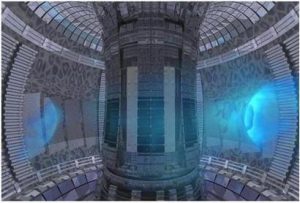
Nuclear Reactor … assuming Hot Fusion (image credit – Aaron Gage)
Another reason to have the three reactors in three hulls set away from the saucer hull is to reduce the exposure to any low level radiation from the reactors on the people and electronic equipment in the saucer hull. While the reactors will be heavily shielded to block the release of radiation, some gamma radiation and neutron radiation will still escape at a low level. So “distance attenuation” is a strategy used to further reduce this radiation. Distance attenuation takes advantage of the fact that radiation from the reactors falls off by the inverse-square law. While short term exposure will cause no ill effects on a person’s health, such as when workers or visitors are in the main engine hull or aux engines hulls, long term exposure might pose a small health risk. Thus the reactors are located at least 250 feet away from the saucer hull at all points.
Key systems on board the Gen1 Enterprise that will need electrical power generated by the nuclear power system are:
- The three electric propulsion engines
- Electronic equipment (communications, ship control hardware, computers, sensors)
- High-temperature electrolysis (produces oxygen to breath and hydrogen as propellant) – uses both electrical power and reactor thermal power
- Air recycling
- Heating, cooling, and air conditioning – uses electrical power and reactor thermal power for heating
- Lighting
- Gravity wheel electromagnets
- Elevators
- Active radiation shield
- Water pumps
- Food preparation equipment including stoves
- Spaceport motorized doors
- 100MW laser
- Research labs
- Manufacturing equipment
The three nuclear power subsystems will have the need to get rid of waste heat resulting from inefficiencies in the heat-to-electrical power conversion process. The ship’s outer hulls are covered almost entirely in aluminum, and this aluminum is used to radiate this waste heat into space. In fact, this is one of the reasons to use aluminum as the material covering the outer hulls. Specialized and more efficient radiators will also be included locally on the main engine hull and/or the two aux engine hulls; for example Lamontagne flat fin radiators might be used.

The heat output from the reactors can also be used to provide direct heating where needed within the Enterprise. Pipes can carry heated water or other fluid throughout the ship for implementing a hydronic radiant heating system. Using radiate heating, rather than heating air and then recirculating this air around the ship, maximizes comfort for humans on board by eliminating cold spots and drafty areas inside the immense ship. Reactor heat can also be used to make hot water for washing clothes, washing dishes, use in sinks, use in showers, and so on.
The heat output of the reactors, at the high temperatures available near the reactor cores, can also be used to facilitate high-temperature electrolysis. This electrolysis is used to break down water (H2O) stored in tanks to produce oxygen to breath and hydrogen as propellant for the electric propulsion engines. This method is desirable because it allows oxygen and hydrogen to be stored as water until needed for non-water applications. If a reactor core is near 2000 degrees C then very little electrical power is needed in addition to the reactor thermal power to break water down into oxygen and hydrogen.
Nuclear Reactor Types
Depending on which technology is found to be most suitable for a gigawatt-class nuclear power system that meets the Gen1 Enterprise’s 20-year development window, the nuclear reactor may be fission-based, Hot Fusion based, or Cold Fusion based.
Fission is by far the most mature reactor technology, but fission raises safety concerns with many people. Safety concerns include during the launch operation to get radioactive materials into space and also when having large fission-based reactors on board the Enterprise while the ship is in Earth’s orbit. One possible solution to the reactors-in-orbit concern is to put the radioactive materials in orbit around the moon, and the Enterprise only picks them up and installs the materials in the reactors when going on a long mission such as to Mars.
Hot Fusion technology is not yet ready and cannot likely be counted on for the Gen1 Enterprise. Hot Fusion systems are extremely complex and no system to date has generated more output power than has been input to it. However, systems such as that being researched at Lockheed Skunkworks should be investigated even if they are long shots for use on the Enterprise.
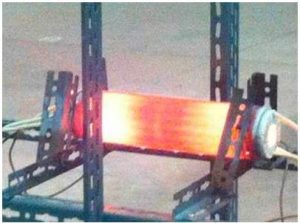
Leonardo Corporation’s “Hot ECAT” LENR Reactor Prototype
Cold Fusion, today often known as Low Energy Nuclear Reactions (LENR), is surprisingly far along in the research stage and several companies claim to have LENR-based reactors nearly ready to bring to market. This is largely unknown because these developments go unreported in the mainstream news media due to the skepticism about Cold Fusion that was brought on by the controversial Pons and Fleischmann experiments of 1989. If LENR reactors truly work, and advanced versions can generate heat in the 1000-2000 degree C range, this would be an ideal technology fit for the Gen1 Enterprise. A nuclear power system based on LENR reactors would be ideal because this would eliminate the safety concerns of fission reactors and the complexity and poor efficiency of Hot Fusion reactors.
Back-up Power
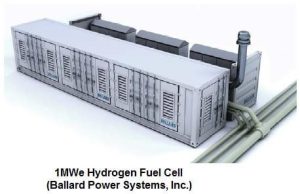
In case of an emergency any one or all of the three reactors located with the three engine hulls can be jettisoned away from the ship. For this reason at least two hydrogen fuel cells, that can generate 1MWe each, will be contained within the saucer hull for backup electrical power. These fuel cells can power the ship’s essential functions, although they are too small to power any of the three main electric propulsion engines. A 1MWe hydrogen fuel cell is now available on earth, made by Ballard Power Systems, as shown above. Of course a space version of this would be a new design, but the fact that such a thing exists on Earth is a good indication that a fuel cell for the Enterprise on this scale is feasible.
One concern with hydrogen fuel cells is that hydrogen must be stored on board the Enterprise. This is not desirable for safety reasons. For example, the electric propulsion engines might not use hydrogen as their primary propellant due to the safety concern of having vast quantities of hydrogen being transported around the ship. (A gas leak, if ignited, will cause an explosion.) In the case of fuels cells, much less hydrogen must be stored. Also, NASA has a lot of experience with using hydrogen fuel cells in spacecrafts. But neither of these justifications is entirely satisfactory. A goal for the design team will be to consider substitutes for hydrogen fuel cells.
However, the risks from handling hydrogen gas are preferable to adding small nuclear reactors for backup power inside the saucer hull. A meteor strike on a reactor inside the saucer hull might spread radioactive contamination over large sections of the saucer hull and create a great hazard for humans. Whatever the final answer, the design team should be very careful about using any explosive gas aboard the Enterprise.
Ship Specs
Engines
Power Systems
Shielding
Engines
Ship Development Philosophy

About the author.

Dr. Myers brings 24 years of diverse field experience, having contributed significantly to multiple domains. Notably, from 2000 to 2016, Dr. Myers was an integral part of a think tank group led by a retired US Marshal, collaborating closely with esteemed professionals such as US Navy Capstone John Shelbourne in high-end Research & Development and retired NASA Yellow Team scientist Bob Berman. During this time, Dr. Myers gained profound insights into nanotechnology and various cutting-edge technologies.
Dr. Myers’ expertise extends beyond technology, encompassing cross-correlating scientific consulting, manufacturing, business plan operations, patents, and understanding global societies. Academically, Dr. Myers holds dual bachelor’s degrees in Game Design and Global Business Management, a Master’s in Business, and a PhD in Organizational Leadership.
With a rich background in consulting across various fields, Dr. Myers has successfully helped businesses grow, some of which were sold or transitioned into retirement. Constantly evolving, Dr. Myers now shares a unique perspective on how the world can progress towards a “Star Trek” society, where the majority of our economic problems are solved, fostering a future of innovation and collaboration.
Dr. Myers

Books Coming Soon~

Dr Myers Auto Biography
Battle Tech Knights
Salesforce Application Development Leadership

Upcoming book!
Part 2 Level 1 Society A Energy & Financial Blueprint To A Global Society Of Evolution~
Discount on books.
Get updates, be part of a future community.